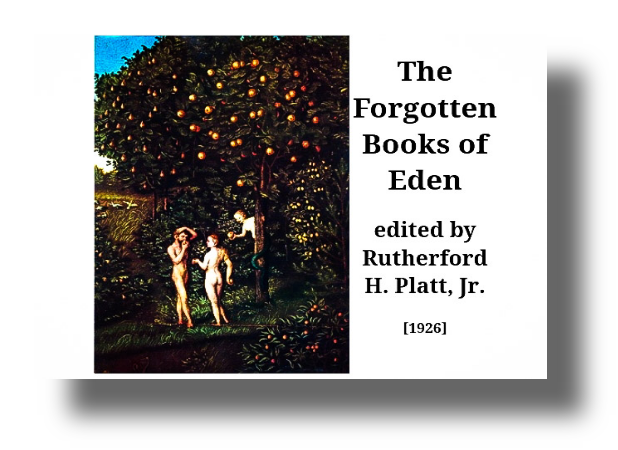
THE FORGOTTEN BOOKS OF EDEN 

​​Chapter one of “The Forgotten books of Eden.” 

Book I. 

Adam and Eve

The crystal sea God commands Adam expelled from Eden to dwell in the cave of treasures.


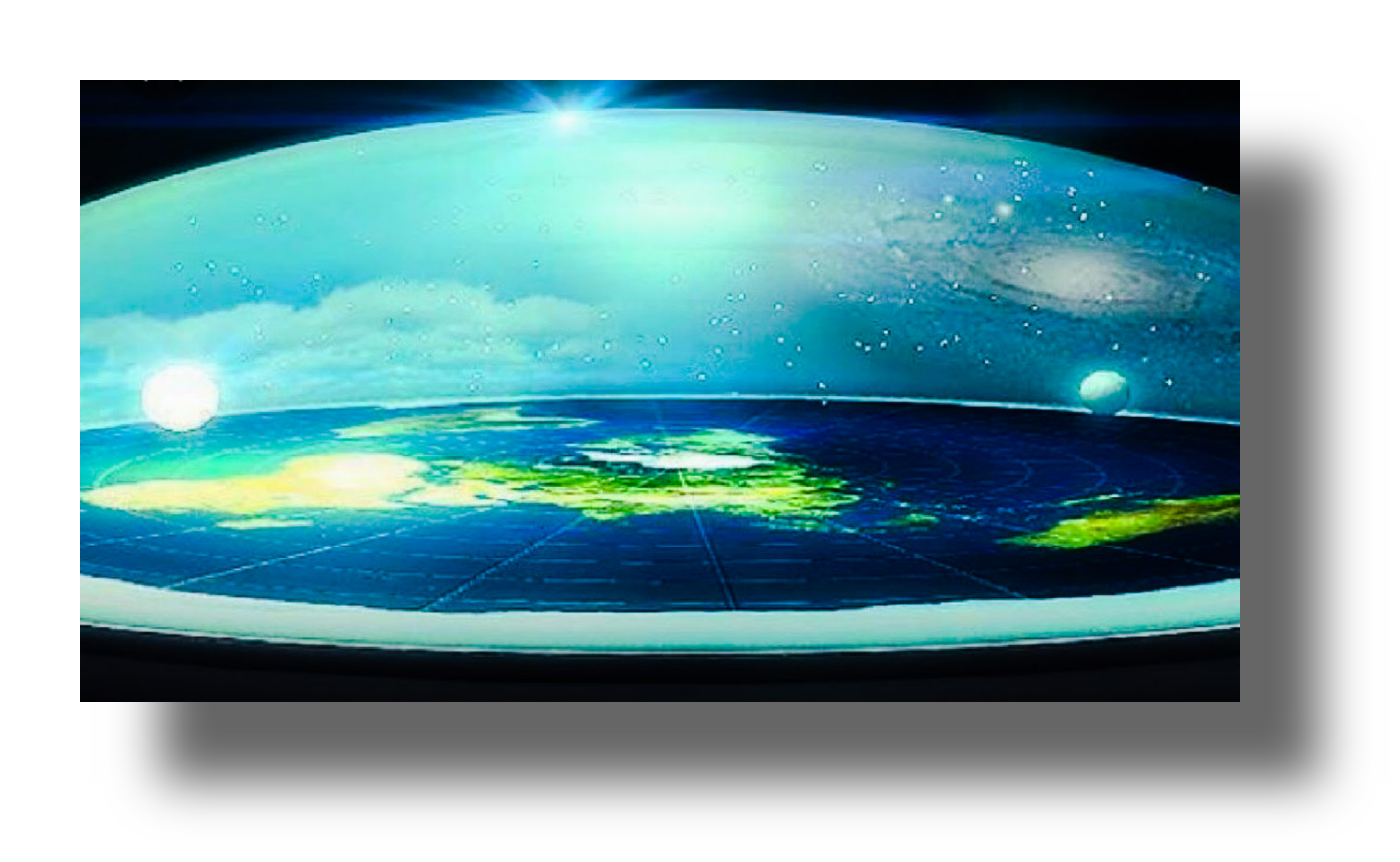
I. On the third day, God planted the garden in the east of the Earth, on the border of the world eastward, beyond which, towards the Sun-rising, one finds nothing but water, that encompasses the whole world, and reaches onto the borders of heaven.

2. And to the north of the garden there is a sea of water, clear and pure to the taste, like on to nothing else, so that, through the clearness thereof, one may look into the depths of the Earth.

3. And when a man washes himself in it, becomes clean of the cleaness thereof, and white of its whiteness– even if it were dark.

4. And God created that sea of His own good pleasure, for He knew what would come of the man He should make; so that after he had left the garden, on account of his transgression, men should be born in the earth, from among whom righteous ones should die, whose souls God would raise at the last day; when they should return to their flesh; should bathe in the water of that sea, and all of them repent of their sins.

5. But when God made Adam go out of the garden, He did not place him on the border of it northward, lest he should draw near to the sea of water, and he and Eve wash themselves in it, be cleansed from their sins, forget the transgression they had committed, and he no longer reminded of it in the thought of their punishment.

6. Then, again, as to the southern side of the garden, God was not pleased to let Adam dwell there; because, when the wind blew from the north, it would bring him, on that southern side, the delicious smell of the trees of the garden.

7. Wherefore God did not put Adam there, lest he should smell the sweet smell of those trees forget his transgression, and find consolation for what he had done, take delight in the smell of the trees, and not be cleansed from his transgression.

8. Again, also, because God is merciful and of great pity, and governs all things in a way He alone knows–He made our father Adam dwell in the western border of the garden, because on that side the earth is very broad.

9. And God commanded him to dwell there in a cave in a rock–the Cave of Treasures below the garden.

Eve Makes Intercession And So Does Dawna~

The Forgotten Books of Eden, by Rutherford H. Platt, Jr., [1926], at sacred-texts.com

CHAP. V.

image

In which Eve makes a noble and emotionable intercession, taking the blame on herself.

THEN Adam and Eve entered the cave, and stood praying, in their own tongue, unknown to us, but which they knew well.

2 And as they prayed, Adam raised his eyes, and saw the rock and the roof of the cave that covered him overhead, so that he could see neither heaven, nor God’s creatures. So he wept and smote heavily upon his breast, until he dropped, and was as dead.

3 And Eve sat weeping; for she believed he was dead.

4 Then she arose, spread her hands towards God, suing Him for mercy and pity, and said, “O God, forgive me my sin, the sin which I committed, and remember it not against me.

5 “For I alone caused Thy servant to fall from the garden into this lost estate; from light into this darkness; and from the abode of joy into this prison.

6 “O God, look upon this Thy servant thus fallen, and raise him from his death, that he may weep and repent of his transgression which he committed through me.

7 “Take not away his soul this once; but let him live that he may stand after the measure of his repentance, and do Thy will, as before his death.

8 “But if Thou do not raise him up, then, O God, take away my own soul, that I be like him; and leave me not in this dungeon, one and alone; for I could not stand alone in this world, but with him only.

9 “For Thou, O God, didst cause a slumber to come upon him, and didst take a bone from his side, and didst restore the flesh in the place of it, by Thy divine power.

10 “And Thou didst take me, the bone, and make me a woman, bright like him, with heart, reason, and speech; and in flesh, like unto his own; and Thou didst make me after the likeness of his countenance, by Thy mercy and power.

11 “O Lord, I and he are one and Thou, O God, art our Creator, Thou are He who made us both in one day.

12 “Therefore, O God, give

him life, that he may be with me in this strange land, while we dwell in it on account of our transgression.

13 “But if Thou wilt not give him life, then take me, even me, like him; that we both may die the same day.”

14 And Eve wept bitterly, and fell upon our our father Adam; from her great sorrow.

My sincere prayer
By Dawna Bowles
April 15, 2016

image

1.) I, Donna make a noble and emotionable intercession, taking the blame on myself for the spiritual death of my children.

When I, and my children entered the cave. I stood praying in my own words not knowing how to pray to God.

2.) And as I prayed, my children raised their eyes, and saw the rock and the roof of the cave that covered them overhead, so that they could see neither heaven, nor God’s creatures. So they wept and smote heavily upon their breast, until they dropped, and was as dead.

3.) And I sat weeping; for I believed they were dead.

4.) Then I  arose, spread my hands towards God, suing Him for mercy and pity, and said, “O God, forgive me my sin, the sin which I committed, and remember it not against me.

5.) “For I alone caused my children to fall from the garden into this lost estate; from light into this darkness; and from the abode of joy into this prison.

6.) “O God, look upon this Thy children that’s fallen, and raise them from their death, that they may weep and repent of their  transgression which they committed through me.

7.) “Take not away their souls this once; but let them live that they may stand after the measure of their repentance, and do Thy will, as before their death.

8.) “But if Thou do not raise them up, then, O God, take away my own soul, that I be like them; and leave me not in this dungeon, one and alone; for I could not stand alone in this world, but with them only.

11.) “O Lord, I and they are one and Thou, O God, art our Creator, Thou are He who made us all in that day.

12.) “Therefore, O God, give them life, that they may be with me, as one, with You in this strange land, while we dwell in it on account of our transgressions.

13.) “But if Thou wilt not give them life, then take me, even me, like them; that we all may die the same day.”

14.) And I wept bitterly in great sorrow because of my transgression and that I caused the death of my precious children.

The first book of Adam and Eve

The Forgotten Books of Eden, by Rutherford H. Platt, Jr., [1926], at sacred-texts.com

The first book of Adam and Eve

                  CHAPTER II

Adam and Eve faint upon leaving the Garden. God sends His word to encourage them.

BUT when our father Adam, and Eve, went out of the garden, they trod the ground on their feet, not knowing they were treading.

2 And when they came to the opening of the gate of the garden, and saw the broad earth spread before them, covered with stones large and small, and with sand, they feared and trembled, and fell on their faces, from the fear that came upon them; and they were as dead.

3 Because–whereas they had hitherto been in the garden-land, beautifully planted with all manner of trees–they now saw themselves, in a strange land, which they knew not, and had never seen.

4 And because at that time they were filled with the grace of a bright nature, and they had not hearts turned towards earthly things.

5 Therefore had God pity on them; and when He saw them fallen before the gate of the garden, He sent His Word unto father Adam and Eve, and raised them from their fallen state.

Next: Chapter III…http://www.sacred-texts.com/bib/fbe/fbe007.htm

~The Forgotten Books of Eden~

One critic has said of this writing:

“This is we believe, the greatest literary discovery that the world has known. Its effect upon contemporary thought in molding the judgment of the future generations is of incalculable value.
image

The Forgotten Books of Eden, by Rutherford H. Platt, Jr., [1926], at sacred-texts.com

THE FIRST BOOK OF

Adam and Eve

ALSO CALLED

The Conflict of Adam and Eve with Satan.

PRESENT day controversy that rages around the authenticity of the Scriptures and how human life began on this planet must pause to consider the Adam and Eve story. Where does it come from? What does it mean?

The familiar version in Genesis is not the source of this fundamental legend, it is not a spontaneous, Heaven-born account that sprang into place in the Old Testament. It is simply a version, unexcelled perhaps, but a version of a myth or belief or account handed down by word of mouth from generation to generation of mankind-through the incoherent, unrecorded ages of man it came–like an inextinguishable ray of light that ties the time when human life began, with the time when the human mind could express itself and the human hand could write.

This is the most ancient story in the world–it has survived because it embodies the basic fact of human life. A fact that has not changed one iota; amid all the superficial changes of civilization’s vivid array, this fact remains: the conflict of Good and Evil; the fight between Man and the Devil; the eternal struggle of human nature against sin,

That the Adam and Eve story pervaded the thoughts of ancient writers is seen in the large number of versions that exist, or whose existence may be traced, through the writings of Greeks, Syrians, Egyptians, Abyssinians, Hebrews, and other ancient peoples. As a lawyer might say who examines so much apparently unrelated evidence–there must be something back of it.

The version which we give here is the work of unknown Egyptians (the lack of historical allusion makes it impossible to date the writing). Parts of this version are found in the Talmud, the Koran, and elsewhere, showing what a vital rôle it played in the original literature of human wisdom.

The Egyptian author first wrote in Arabic (which may be taken as the original manuscript) and that found its way farther south and was translated into Ethiopic. For the present English translation we are indebted to Dr. S. C. Malan, Vicar of Broadwindsor, who worked from the Ethiopic edition edited by Dr. E. Trumpp, Professor at the University of Munich. Dr. Trumpp had the advantage of the Arabic original, which makes our bridge over the gap of many centuries a direct one.

The reading of these books is an adventure. You will find the mind of man fed by the passions, hopes, fears of new and strange

earthly existence rioting, unrestrained, in the zest of self-expression. You roam in the realms of mythology where swiftly the aspects of nature assume manifold personalities, and the amorphous instinct of sin takes on the grotesqueries of a visible devil.

From such imaginative surroundings you find yourself suddenly staring at commonplace unvarnished events of family life–and such a family as “the first earthly family” was! They had all the troubles, all the petty disagreements, and the taking sides with one another, and the bother moving, and “staying with the baby,” that in the total mark family life to-day. You will see it when you peep beneath the overlaying glamour of tradition.

One critic has said of this writing:

“This is we believe, the greatest literary discovery that the world has known. Its effect upon contemporary thought in molding the judgment of the future generations is of incalculable value.

“The treasures of Tut-ank-Amen’s Tomb were no more precious to the Egyptologist than are these literary treasures to the world of scholarship.”

But we prefer to let the reader make his own exploration and form his own opinion. The writing is arresting enough to inspire very original thoughts concerning it,

In general, this account begins where the Genesis story of Adam and Eve leaves off. Thus the two can not well be compared; here we have a new chapter–a sort of sequel to the other. Here is the story of the twin sisters of Cain and Abel, and it is notable that here the blame for the first murder is placed squarely at the door of a difference over Woman.

The plan of these books is as follows:–

Book I. The careers of Adam and Eve, from the day they left Eden; their dwelling in the Cave of Treasures; their trials and temptations; Satan’s manifold apparitions to them. The birth of Cain, of Abel, and of their twin sisters; Cain’s love for his own twin sister, Luluwa, whom Adam and Eve wished to join to Abel; the details of Cain’s murder of his brother; and Adam’s sorrow and death.

Book IL The history of the patriarchs who lived before the Flood; the dwelling of the children of Seth on the Holy Mountain–Mount Hermon–until they were lured by Henun and by the daughters of Cain, to come’ down from the mountain. Cain’s death, when slain by Lamech the blind; and the lives of other patriarchs until the birth of Noah.

Chapter I

The crystal sea. God commands Adam, expelled from Eden, to dwell in the Cave of Treasures.

1. ON the third day, God planted the garden in the east of the earth, on the border of the world eastward, beyond which, towards the sun-rising, one finds nothing but water, that encompasses the whole world, and reaches unto the borders of heaven.

2. And to the north of the garden there is a sea of wafer, clear and pure to the taste, like unto nothing else; so that, through the clearness thereof, one may
look into the depths of the earth.

3. And when a man washes himself in it, becomes clean of the cleanness thereof, and white of its whiteness–even if he were dark.

4. And God created that sea of His own good pleasure, for He knew what would come of the man He should make; so that after he had left the garden, on account of his transgression, men should be born in the earth, from among whom righteous ones should die, whose souls God would raise at the last day; when they should return to their flesh; should bathe in the water of that sea, and all of them repent of their sins.

5. But when God made Adam go out of the garden, He did not place him on the border of it northward, lest he should draw near to the sea of water, and he and Eve wash themselves in it, be cleansed from their sins, forget the transgression they had committed, and he no longer reminded of it in the thought of their punishment.

6. Then, again, as to the southern side of the garden, God was not pleased to let Adam dwell there; because, when the wind blew from the north, it would bring him, on that southern side, the delicious smell of the trees of the garden.

7. Wherefore God did not put Adam there, lest he should smell the sweet smell of those trees forget his transgression, and find consolation for what he had done, take delight in the smell of the trees, and not be cleansed from his transgression because God is merciful and of great pity, and governs all things in a way He alone knows–He made our father Adam dwell in the western border of the garden, because on that side the earth is very broad.

9 And God commanded him to dwell there in a cave in a rock–the Cave of Treasures below the garden.

Next: Chapter II
Read more and original here: http://www.sacred-texts.com/bib/fbe/fbe018.htm