

Tim Ballard’s Reputation is in Shambles. The Americans He Helped Arrest Want Answers.
Tim Ballard, the disgraced “anti-sex-trafficking” expert, was the subject of a hit 2023 biographical film and serial sexual misconduct allegations in the same year. After Ballard’s fall, the people he helped arrest in Washington want to know why no one seems willing to take a second look at their cases.
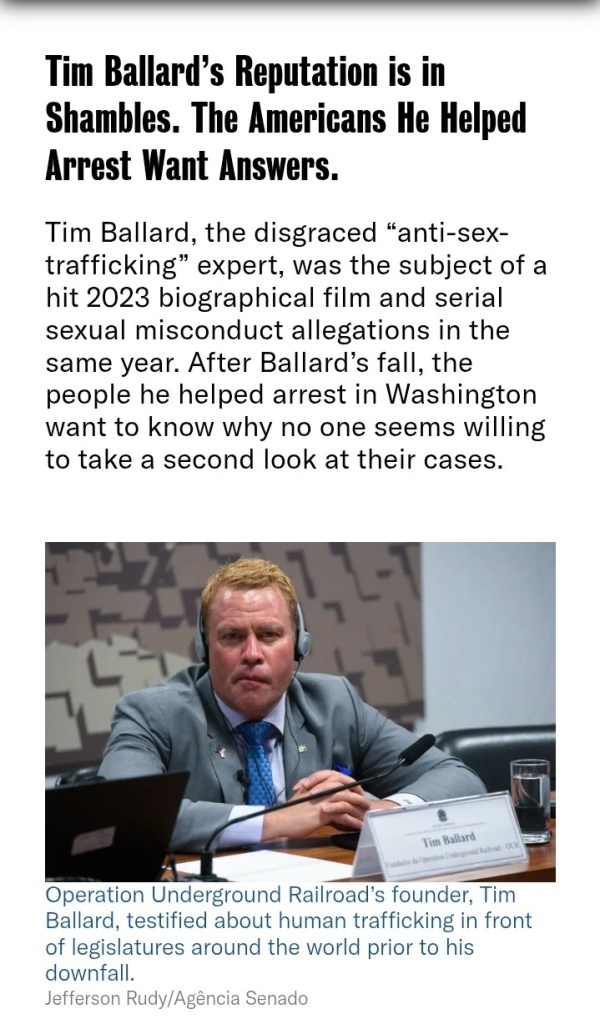
Operation Underground Railroad’s founder, Tim Ballard, testified about human trafficking in front of legislatures around the world prior to his downfall.
Operation Underground Railroad’s founder, Tim Ballard, testified about human trafficking in front of legislatures around the world prior to his downfall.
Jefferson Rudy/Agência Senado
Kevin Light-Roth
Dec 09, 2025
Back in 2014, a Washington State Patrol sergeant named Carlos Rodriguez was hunting for money. His unit, the Missing and Exploited Children Task Force, faced a budget shortfall, and legislators were of little help—they were in the midst of broad austerity measures, and their mood was decidedly tightfisted. Rodriguez needed a new revenue source to tap. Amid the crisis, a coworker happened to tell Rodriguez about Operation Underground Railroad (OUR), a nonprofit group out of Utah that had been privately organizing and funding its own international sex trafficking sting operations. Inspiration struck, and Rodriguez reached out to OUR and its founder, Tim Ballard.
The details of the negotiations between Rodriguez and OUR are not known, but the result was a signed contract: OUR would fund a series of stings carried out by Rodriguez’s task force. The operations would follow a formula popularized by Dateline’s “To Catch A Predator” series: Police officers would portray themselves as minors—or as adults facilitating contact with minors—in internet chatrooms and encourage men to meet up with them for sex. The undercover officer would provide an address. In the event that a targeted person showed up, he would be confronted by a SWAT-like police team and arrested.
Rodriguez supervised the first collaborative sting operation in Aug. 2015. OUR staff embedded with the Missing and Exploited Children Task Force, providing training as well as financial backing to the tune of $20,000. The sting itself was originally dubbed Operation Underground Railroad, though in later press releases, it was rechristened Operation Net Nanny.
Ezra Wright was 20 years old when he was arrested during a Net Nanny operation in 2016. The circumstances surrounding his arrest were typical of the stings. He responded to a “casual encounter” ad posted by an undercover Washington State Police (WSP) officer identifying himself as an adult woman on a website that was supposed to be exclusively adult.
“It was more of a scam” than it was detective work, Dan Wright, Ezra’s father, told The Appeal. Wright says the undercover operative approached his son with “a very fast-paced” solicitation, “heavily steering the conversation” toward an in-person hookup. Convinced that the person he exchanged messages with was a grown woman engaged in elaborate role-play, Ezra Wright took the bait. He drove to the address he was given and knocked on the door. In the next moment, Washington State Patrol officers ordered him to the ground at gunpoint.
At first glance, Net Nanny was an unqualified success. The stings landed hundreds in prison and put hundreds more on lifetime sex offender registries. Rodriguez’s task force was comfortably funded, its members swimming in overtime pay.
In return for the funding, Rodriguez and WSP helped supply OUR with positive media exposure and sensational arrest numbers that the organization could use to impress donors.
This last item filled a critical gap in Ballard’s fundraising spiel. For years, Ballard had been leading foreign sting operations through OUR in Asia and South and Central America. But he operated under tight constraints. He was not a law enforcement agent, could not make arrests, and could not operate on American soil, or inside any nation with a fully functional government. Donors wanted to hear about operations in cities with familiar names, about arrests and convictions, and the lengths of prison sentences. Obtaining a legitimate law enforcement proxy was a substantial coup for Ballard.
Operation Net Nanny even helped elevate Tim Ballard to a certain level of national celebrity, culminating in the 2023 film “Sound of Freedom,” which turned Ballard’s exploits into big-screen action fodder. But his reputation cratered almost instantly, following accusations that Ballard himself had sexually abused and trafficked women for years. In the wake of Ballard’s public disgrace, some members of the mainstream press finally lent an ear to the numerous experts, activists, and family members who’d long said that Ballard’s arrest tactics were, themselves, suspect and potentially illegal.
And as the combined weight of investigations and lawsuits reached critical mass, the families of the men Operation Net Nanny sent to prison began asking why no one was willing to take a second look at their loved ones’ convictions.
Ballard grew up a Mormon in California, attended Brigham Young University, and eventually settled permanently in Utah. Before starting OUR, Ballard claims to have worked for the CIA, but members of the media have struggled to confirm details about his story, and Ballard has since removed references to the agency from his social media pages. Ballard also says he worked for the U.S. Department of Homeland Security, though that agency has not confirmed it once employed him. Ballard has told interviewers that he felt government regulations limited the sort of actions he could take to help sex trafficking victims. He left to create his own nonprofit and founded OUR in 2013.
In the decade since the first Net Nanny stings, Ballard developed Operation Underground Railroad—now called “Our Rescue”—into a multimillion-dollar organization. In 2023 tax filings, OUR said it received more than $40 million in donations that year. Ballard also claimed to have rescued more than 6,000 children from sex trafficking operations and to have facilitated the arrests of 5,000 traffickers. (OUR has since backed away from those lofty figures.) As the pedophilia-obsessed QAnon conspiracy theory took root in conservative politics, Republican politicians and talking heads began uplifting Ballard as a hero. Right-wing media star Glenn Beck accompanied Ballard on a trip to Thailand in 2017. In 2019, President Donald Trump appointed Ballard to a White House position. And, in 2023, Jim Caviezel starred as Ballard in “Sound of Freedom,” a highly fictionalized Hollywood version of OUR’s child trafficking sting operations in South America and Southeast Asia. The film stunned the film industry by netting a nearly quarter billion in profits off of a $14 million budget. Trump hosted a screening of “Sound of Freedom” at his New Jersey golf club.
When Utah Senator Mitt Romney revealed his plans to retire, Ballard appeared on Fox News to say he was considering a run for Romney’s vacant seat. He had political backers and a compelling story. He had name recognition. His congressional bid was rapidly gaining momentum.
But the fall was swift and catastrophic. Barely two months after “Sound of Freedom” hit theaters, Operation Underground Railroad formally announced Ballard’s departure. He’d been gone since June, the statement said, though the organization initially kept this quiet. Soon after the announcement, five women filed suit against Ballard, OUR, and several affiliated groups, accusing Ballard of being a serial sexual predator. All the women were former OUR employees.
According to the lawsuit, Ballard habitually pressed female coworkers to join him on what he said were child rescue operations, and to take part in what Ballard called “the couple’s ruse”. Traveling to the most dangerous places in countries like the Dominican Republic and Ecuador, the women were to pose as Ballard’s wives, in order to deceive child traffickers and allay any suspicions they might have. To prepare them for the role, Ballard would kiss, grope, and otherwise engage the women physically. The unwanted sexual contact would continue during an overseas operation. Ballard, the lawsuit alleges, coaxed the women into allowing him to fondle them in strip clubs and brothels, and to shower with him and sleep in the same bed in hotel rooms.
These allegations were exquisitely damning in light of the fact that OUR, and Ballard himself, claimed to be on a crusade ordained by God to eliminate sexual exploitation. During a press conference held on the steps of the Utah Capitol building, attorneys for the lawsuit’s plaintiffs noted the obvious and vulgar irony that as Ballard carried out sex trafficking “sting operations,” he was himself sexually trafficking the women who volunteered to help him.
Their lawsuit was reportedly the eighth Ballard faced that year.
Ballard insists that he is innocent and has filed a defamation countersuit against his accusers. He declined to comment for this story.
Following the destruction of Ballard’s reputation, criticism that had long circulated regarding OUR and its operations began bobbing up in media coverage of the sexual battery allegations. Many in the law enforcement community publicly disparaged the organization’s stings as merely performative stunts to draw funding, resulting in neither the rescue of trafficking victims nor the prosecution of traffickers. People who had volunteered in OUR stings came out to decry them as amateurish and reckless. There were profoundly distressing stories concerning several organizations within the constellation of OUR affiliates, including an orphanage in Haiti where OUR sent children it purportedly rescued, and at which those children were raped and subjected to forced abortions.
At the same time, a local Utah prosecutor reportedly began investigating Ballard for fraud, in addition to possible incidents of human trafficking and sexual assault. As the combined weight of investigations and lawsuits seemed to reach critical mass, the families of the men Ballard sent to prison began asking why no one was willing to question their loved ones’ convictions.
For Joanne, who asked that her last name be withheld due to threats her family has received in the past, the news reports were a long overdue vindication. Her son, Bryan, had been swept up in a Net Nanny sting in 2016.
Court records show Joanne’s son encountered an undercover Net Nanny officer on an adult dating site. When the officer suggested a sexual rendezvous that included the officer’s fictitious children, Bryan ended the exchange.
At this point, says Seattle defense attorney Heather Kelly, law enforcement should have moved on.
“If someone rejects an advance by law enforcement, the investigation should cease. The same is true if the person breaks off communication and there is no independent evidence that the person is involved in illegal activity.”
Instead of disengaging, the undercover officer contacted Bryan again 16 hours later. Bryan and the officer sent a few messages back and forth before Bryan again stopped replying. The officer waited 18 more hours and then reached out a third time.
In the end, the officer’s solicitations persuaded Bryan.. He drove from his parents’ home east of Seattle to a residence some fifty miles away where the woman from the dating site said they should meet. His idea was that if the woman was not interested in a one-on-one encounter, he would leave. He was, of course, driving into a trap, and was arrested.
By the time Tim Ballard was publicly disgraced, Joanne had spent seven years campaigning for an investigation into OUR and its partners. Now that the world could see their seediness, she thought, it was only a matter of time before someone took a hard look at Operation Net Nanny.
“We were ecstatic in hopes that something will finally be done,” says Joanne. “I thought ‘Thank God for these brave women. We have been stating this for years without anybody believing us.”
“Families have been devastated,” says Joanne’s husband, Bruce. “People have sold their homes to pay attorneys. People have had to move out of the state. We have been convicted and sentenced right along with our loved ones.”
Kelly calls the Net Nanny stings “inefficient and largely a waste of taxpayer money,”noting the number of law enforcement staff needed to carry out a sting, as well as the cost of litigating cases in which there are issues with entrapment. Where police are “luring people into behaving in a way that they would not otherwise have behaved, and are then arresting them for that behavior,” Kelly says, “the arrest is unconstitutional.”
Arrestees have asserted that Net Nanny operatives draw in ordinary people by using deliberately confusing language and images. According to a 2020 New York Times Magazine article, one undercover officer posing as a child in a Net Nanny sting claimed she was 13 years old, but deployed phrases typically used by adults, sent sophisticated driving directions, and provided a photo of a grown woman who appeared to be well into her 20s.
In 2021, Quentin Parker sued WSP for alleged entrapment after he was arrested in a Net Nanny sting. Parker says an officer portrayed herself as a single mother on an adult dating site and used coy, ambiguous BDSM terminology that implied she was looking for a roleplaying scenario involving consenting adults pretending to be underage. As he stepped inside the home where they agreed to meet, he says a SWAT team stormed into the room and cuffed him.
When stories about the allegations against Tim Ballard began flooding the news, Aracely Yates was far from astonished.
“It’s about damn time,” Yates remembers thinking. “We’ve known for years that Tim Ballard is a shameless, lying, actual predator.” Like Joanne, he anticipated that Ballard’s integral connection to the origin and design of Operation Net Nanny would necessarily trigger an investigation.
Yates’s son was arrested in a Net Nanny sting after responding to a “w4m” ad on an adult-only website. The person described herself as an adult woman seeking a “casual encounter” later that night. The website Yates’s son was scrolling through required users to agree to certain terms and conditions, including that they were over 18 and not misrepresenting themselves in any way. Because of these ostensible safeguards, Yates says, her son believed he could only be chatting with a grown woman.
Genuine predators have been arrested in Net Nanny stings. Last year, Nikolay Mirgorodeskiy of Cowlitz County, Washington had condoms and child porn in his possession when he arrived at what he believed to be the home of a 13-year-old boy. Some—fewer than one in ten—arrestees had histories of sex offenses. A few have committed sex crimes since their Net Nanny arrests. Braxton Hood, who was picked up in the same sting as Mirgorodeskiy, had been charged with inappropriate contact with a fifteen-year-old girl in an unrelated incident four months earlier.
Pedophilia can be a difficult disorder to study, given that few people willingly admit to suffering from it. But the idea that dozens of predators would be both concentrated in a county of 30,000 and hunting for people they don’t know flies in the face of what we do know about the condition. For one, child sexual assaults are overwhelmingly not committed by strangers. According to the U.S. Department of Justice’s National Crime Victim Survey, relatives, romantic partners, and other people known to the victim were responsible for the vast majority of juvenile sexual abuse cases between 1993 and 2023, the last year for which data is available.
Likewise, attorney Heather Kelly considers it unlikely that predators would all simultaneously be looking for children on adult-only dating sites like OK Cupid and Plenty of Fish. That’s not how predators work in real life, Kelly says, and it’s particularly improbable if the website has safeguards in place that are designed to prevent children from joining.
“People who are seeking to victimize a particular demographic tend to look in places where that demographic has a reputation for congregating rather than places from which they are barred,” Kelly says.
Brandon James, a former undercover FBI operative, 25 year veteran of the Seattle Police, and federally recognized expert on covert and undercover operations, evaluated the Net Nanny stings during a deposition with defense attorneys last year.
“I believe there were mistakes that were made in [Rodriguez’s] investigations,” said James, explaining that “the chats they were doing were aggressive” and that this sort of aggressiveness can become entrapment. James referenced complaints against Rodriguez leveled by former prosecutor Cecilia Gregson and King County Prosecutor Laura Harmon, who prosecuted cases stemming from Net Nanny operations and voiced concerns over entrapment.
“The entrapment issue had been raised on more than one occasion, in more than one jurisdiction,” said James, and “if two separate prosecutors in two separate counties raised the same issue, there’s an issue.”
On February 12, 2016, Captain Mike Edwards of the Seattle Police Department — commander of Washington’s chapter of the Internet Crimes Against Children (ICAC) task force, a national network of federal and local police agencies — issued a warning to Washington law enforcement officials. He admonished them to “by no means” participate in OUR-involved operations, or to utilize personnel, equipment, or any other resources to assist OUR. Edwards viewed OUR as a sort of invasive species, a civilian organization using legally suspect tactics to operate in a space where it did not belong. Working with the organization, Edwards said, would place law enforcement in “serious breach” of the standards of conduct put in place by ICAC’s national program.
Unmoved, Rodriguez oversaw a third Net Nanny sting the same month. OUR employees were once again present. Emails written at the time of the sting reveal that while the partnership between WSP and OUR was going strong, there was a careful effort to publicly distance the Net Nanny stings from OUR. In an internal email sent on February 22, 2016, OUR director of strategic mobilization Sylvia Matayoshi wrote that she had spoken with Rodriguez and that he had “changed some of the language” in a WSP press release regarding the February 17 operation “so that it does not give the perception that we are embedded in the task force.”
Meanwhile, Ballard was frequently citing the successes of Net Nanny stings while fundraising. He characterized them as the progeny of OUR, and emphasized to donors OUR’s role in training those involved. On the OUR website, the organization’s logo appeared alongside the Washington State Patrol insignia.
Matt Osborne of OUR neatly summarized the two faces of the WSP-OUR partnership in an email he authored on February 24, 2016: he acknowledged “the advisability of not posting anything at all about our participation behind the scenes” in a recent Net Nanny operation, but stressed that OUR would nonetheless use that participation as a selling point “behind the scenes with donors.”
Rodriguez’s role in Ballard’s fundraising efforts didn’t end with the stings themselves. In addition to the laudatory press releases and the helpful arrest data, on at least one occasion, while still employed at the state patrol, he openly solicited donations to OUR during a media interview.
But the intimacy of that relationship is best exemplified by what came next. Upon retiring from the Washington State Patrol in June of 2020, Rodriguez immediately pivoted into a new career — domestic coordinator for Operation Underground Railroad.
To date, no legislative body or watchdog agency has opened an investigation into the Net Nanny stings or signaled interest in doing so. Though OUR’s international operations are on hiatus, and many have cut ties to the group, local law enforcement agencies across the country continue to execute stings initially funded or inspired by OUR. Most recently, Jackson County, Oregon carried out a Net Nanny operation on March 13, 2024 arresting six people. In Washington alone, Net Nanny stings have sent nearly 300 people to prison. More than 100 of them remain in custody. Hundreds of others are out of confinement, but bear the lifelong stigma of a sex crime conviction.
Failing a formal inquiry, Aracely Yates is urging journalists and others to “keep digging” into the Net Nanny stings. He believes that sufficient scrutiny will expose corrupt law enforcement practices and allow those who were wrongfully convicted to be “released, cleared and compensated for what they have been put through.”
Dan Wright is skeptical that any reckoning will ever take place. Wright’s son received a nearly four year prison sentence after his Net Nanny arrest, and although he filed a successful appeal that overturned his class-A felony and reduced his parole term from life to a year, he will continue to be listed on sex offender registries until 2031. His family wants an investigation and clings to a small hope that one could happen.
“But we do not expect it,” Wright says.
Many others abandoned hope entirely. Since the Net Nanny operations began, nine of the people arrested have died by suicide.
Carlos Rodriguez maintains that he saved 31 children through his stings. In light of the fact that no real children were involved in them, however, the number has always been an enigma to legal experts. During a deposition last April, attorney Charles Lane asked Captain Edwards how that number was calculated.
“I asked the question of how are you counting this,” said Edwards. He explained that Rodriguez had added up the children in each arrested person’s family, and deemed them rescued. It was a bizarre method that did not align with national standards. “You can’t count those” children in official reports, said Edwards.
Using the formula recognized by Edwards and others in law enforcement, the actual number of children rescued by Operation Net Nanny is zero.
These days Rodriguez teaches a private course on undercover internet chat operations. One segment is a PowerPoint presentation covering his Net Nanny experiences. He calls it, “Lessons Learned.”
Source: Kevin Light Roth https://theappeal.org/net-nanny-washington-state-police-stings/

















 iblogstr8sicit.WordPress.com